
Optional Dividends shouldn’t mean Optional Value

→ $58 billion spent on processing
→ Investors lose up to $10 billion every year due to sub-optimal elections
→ Automation through Euroclear Cash+® provides the solution
The DTCC and The Value Exchange estimate the cost of corporate action processing at $58 billion annually for the US market alone. Inefficient corporate action processing is only part of the problem with investors suffering up to $10 billion per annum in missed performance through sub-optimal elections on corporate actions.
Voluntary corporate actions including tenders, rights issues and optional dividends require an election to be made, or a default option is applied. This often results in missed value for investors and pension fund beneficiaries. On scrip dividends alone, Scorpeo analysis reveals over $1billion per year in missed value and up to $10 billion per annum across all types of corporate actions
According to the DTCC, every corporate action requires multiple interactions from issuers, CSD’s, custodians, operations and investment managers. Corporate actions processing is costing the global financial industry an estimated $58 billion annually, with costs increasing by 10% year over year and automation rates falling below 40%.
Analysis from Citi’s 2025 Asset Servicing report confirms the average corporate action event now touches more than 110,000 firm interactions and every voluntary event costs $34 million to process, with 75% of market participants still relying on manual data revalidation due to lack of trust in data sources.
The objective is to ensure that the corporate action event is communicated across the value chain and accurately delivered to the investment team to allow them to make an election decision.
Investment teams still make over 50% sub-optimal elections
This is where the system fails. A complex ecosystem has evolved to ensure data accuracy from issuers, CSD’s, custodians, intermediaries, and data providers to reach the investment manager. Scorpeo Event Data shows that investment teams are making sub-optimal elections more than 50% of the time.

Why is this happening?
Most asset managers opt not to make any decisions on voluntary corporate actions. This inaction simply leads to lost value.
Every year, there are hundreds of voluntary corporate actions where shareholders are required to make an election. In the case of scrip dividends, this means choosing between receiving a payment in cash or stock. For rights issues, this means opting to purchase more shares. If a shareholder doesn’t actively make an election, then a default selection is automatically made. For scrip dividends, this means receiving a cash dividend payment which is often suboptimal and results in lower returns for investors.
Many managers have not realised the amount of money that’s at stake. This lack of awareness means that looking at the value embedded in voluntary corporate actions is not a priority. Limited time and resource is also a key issue with investment managers at the end of a long corporate action processing chain and having to submit an election with limited time due to internal and overall market deadlines.
Despite efforts to standardize, regulate and introduce new technologies, automation rates for corporate actions have declined increasing both the time it takes to manage a corporate action from end to end, and the number of potential issues requiring manual processing. As a result, issuers and investors are further apart than ever before. The lack of active engagement from investors results in the majority resorting to default election options and losing value.
New initiatives, same problem
Numerous initiatives over the past 10 years have tried to solve the problem of fragmented, inaccurate data to create a ‘golden record’ that all parties can trust and rely upon.
The recent Chainlink initiative utilizing blockchain and AI to agree the golden record, with 24 industry participants including financial market infrastructures Swift, Euroclear, DTCC, and SIX as well as leading asset managers and banks UBS, DBS Bank, BNP Paribas’ Securities Services, ANZ, Wellington Management and Schroders.
Despite these initiatives and the huge cost of processing voluntary corporate actions, the number of sub-optimal elections and the missed value for investors is increasing.
Automation provides the solution - Euroclear taking the lead on innovation
Scorpeo has developed a technology solution to reduce the $1 billion being lost by investors every year on scrip dividend elections and to address the estimated $10 billion being lost across all types of corporate events.
𝗘𝘂𝗿𝗼𝗰𝗹𝗲𝗮𝗿 𝗖𝗮𝘀𝗵+® launched in March 2025 in a partnership between Scorpeo and Euroclear to provide a simple, automated solution through market infrastructure to capture the lost value for investors. Euroclear Cash+ provides investment managers with a 3rd option on scrip dividends to allow them to maximise the value available within optional dividend elections.
Working with CSD’s like Euroclear allows a whole market solution to the problem with no investors being disadvantaged. Custodians and sub-custodians still play an important role in communicating the Cash+ option to their clients and passing elections to CSD’s for processing.
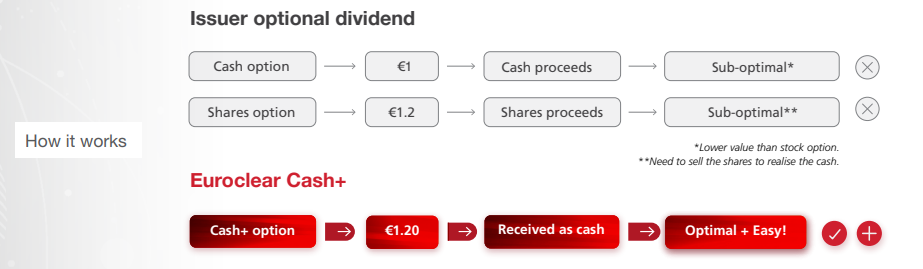
Euroclear Cash+®: How it works
Time for change - putting investors first
The financial services industry is suffering unsustainable costs and friction from corporate action processing. Even when timely and accurate data reaches the investment manager for an election decision, the industry is failing to act in the best interests of investors and pension beneficiaries.
There is urgent need for change. CSD’s in partnership with custodians hold the key to implementing a market infrastructure technology solution which doesn’t disrupt current processes but makes a huge difference to investors. Costs and performance are two sides to the same problem, but the industry is too focused on data processing rather than the performance impact of failing to optimize corporate action elections.
Matt Ruoss, CEO Scorpeo: “The problem the industry is facing is more daunting than many asset managers realise and cannot be ignored. Whether firms decide to leverage their own internal resources or work with a corporate actions technology provider to put an automated system in place, asset managers need to act now.”
He added: “With the tools, technology and processes that exist today, there’s no reason investor beneficiaries should be incurring losses of this magnitude. As an industry, we need to systematically improve the way we optimise corporate actions—these are critical functions that can no longer be neglected. There is no reason that asset managers (or the custodians that act on their behalf) should not utilise technology to capture the full value of voluntary elections for investors.”